How Much Does a Website
Cost in Pune?
Between ₹8,000 for a single-page site and ₹3,00,000 or more for a custom application, with most small-business websites landing between ₹15,000 and ₹60,000. Every page competing for this question publishes a price. Almost none of them publishes what happens to that price afterwards: the tax on it, what changes it, and who owns what it buys.
What does a website actually cost in Pune?
Four tiers cover almost everything sold here, from ₹8,000 to ₹5,00,000. The ranges below are Google’s own summary of this market: according to the AI Overview it serves for this search, most small and medium business websites fall between ₹15,000 and ₹60,000. The nine agency pages ranking beneath it broadly agree.
| Tier | Typical range | What that buys |
|---|---|---|
| One page | ₹8,000 – ₹15,000 | A single campaign, a basic portfolio, a local service promo |
| Small business, 5–8 pages | ₹15,000 – ₹40,000 | Responsive design, contact forms, basic on-page SEO |
| E-commerce store | ₹40,000 – ₹1,50,000 | Product catalogue, payment gateway, shipping rules |
| Custom application | ₹2,00,000 – ₹5,00,000+ | Unique code, user accounts, dashboards, specialised databases |
Those bands are wide because the tier alone does not decide the number. Three things do: how many pages the site carries, whether the words and photographs already exist or have to be produced, and whether anybody needs to edit it after launch without calling a developer.
Our own figures sit inside the second band: ₹20,000 for a static site and ₹30,000 for the CMS tier where the business edits its own content, both at two to four weeks, with the full scope on our pricing page. That is not a claim about being well-priced. It is the same band Google names for most small and medium business sites, which is a more useful thing for a buyer than our opinion of ourselves.
The most-upvoted answer on the biggest forum thread about this question, a Quora discussion carrying more than fifty answers, whose top reply has over twelve hundred votes. Is simply “it depends”. That is honest, and the three factors above are what it depends on.
Why is the cheapest quote cheap?
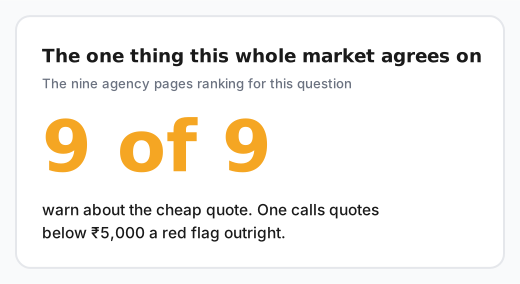
Usually because it is a template that has already been sold several times, and the saving is real, so is what is missing. This is the one thing the whole market agrees on: all nine pages ranking for this question warn about it, and one calls quotes below ₹5,000 a red flag outright.
What tends to be absent at that price is not design. It is everything after launch: no handover, no way to change a price or swap an image yourself, and support that ends when the invoice is paid.
There is a second price on this search worth explaining, because it is the first thing on the screen. A hosting plan is advertised above these results at ₹69 a month, with an AI website builder included. That is a genuine offer and it is not comparable to an agency quote, because it is a different purchase: a builder subscription buys software you operate yourself, while an agency quote buys the work of deciding what the site should say and then building it. Either can be the right choice. Five of the nine pages here do compare builders with agencies, but none of them mentions the advertisement the reader has just scrolled past to reach them.
If the answer is a builder, that is a legitimate outcome and it costs a few thousand rupees a year. If it is an agency, the rest of this page is about the parts of that quote nobody prints.
Is GST included in that number?
In our figures, no: every figure we publish excludes GST, which is added as applicable, and that is stated in the same words on our terms and our pricing page. It is worth asking every quote the same question, because the market does not answer it consistently.
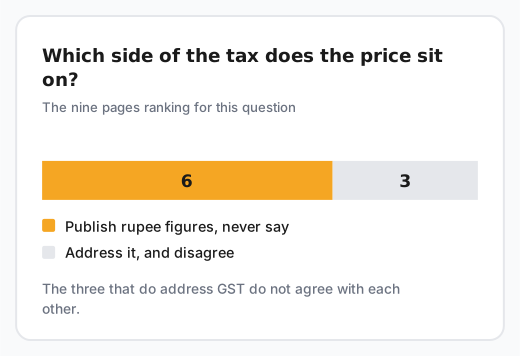
Six of the nine pages ranking for this question publish rupee figures and never say which side of the tax they sit on. The three that do address it do not agree with each other: one states that agencies in Pune generally quote exclusive of GST and that 18% applies to website development; one states that its own listed prices include GST where applicable; and one prints a notice that 18% GST applies to every purchase beside each of its tiers.
None of those is wrong. Agencies genuinely differ, and both treatments are normal. The problem is that a reader comparing three quotes has no way of knowing which convention each one used.
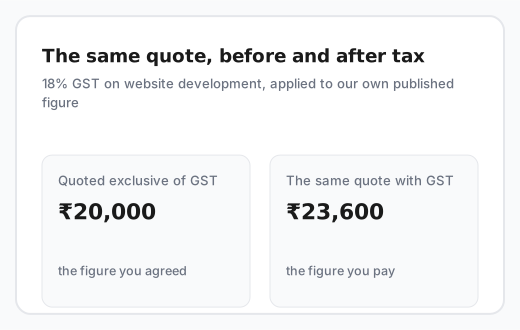
At 18%, a ₹20,000 quote is either ₹20,000 or ₹23,600. That gap is larger than most of the differences between the tiers in the table above, which makes it the single highest-value question on this page. Ask for the figure and its tax treatment in the same sentence, and get the answer in writing.
What turns a quote into a bigger invoice?
A change to what was agreed, not a change of mind about how something looks. That distinction is the whole of it, and none of the nine pages ranking for this question states it.
The line we work to, published on our terms: revisions refine the agreed scope, and a change to the scope itself (new pages, new features, a new direction after approval) is quoted as additional work before that work starts. Moving a section, changing colours and rewriting a paragraph are revisions. Adding a booking system to a brochure site is a new scope.
Two pages in this set come close to the question and neither answers it. One lists “what does the quoted price include?” among the questions to ask a developer, which is good advice that stops short of an answer. The other names revision rounds as something affecting the timeline rather than the price.
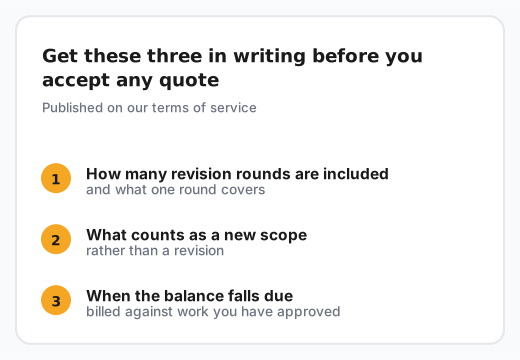
Three things are worth having in writing before you accept any quote, from us or from anyone else: how many revision rounds are included, what counts as a new scope rather than a revision, and when the balance falls due. Ours states its revision rounds and bills against milestones tied to work you have seen and approved, which is described on our process page.
Who owns it when it is paid for?
You do, and one page in this ranking set is already telling readers to make sure of it. It advises confirming in writing that you receive full ownership of the website files, hosting access and the domain before the project starts. That advice is correct, and no other page in this ranking set states it.
What it leaves to the reader is the answer. Ours, published on our terms: you own the final deliverables (design files, website content, and custom code written specifically for you) once the project is paid in full, and until then ownership has not transferred.
There is a carve-out that buyers are often surprised by, so it is better stated plainly than discovered later. An agency’s own pre-existing tools, libraries and internal frameworks stay the agency’s property; what transfers with your site is a perpetual licence to keep using them as part of it. That is normal across the industry and it is not a catch, but it is the difference between owning your website and owning the workshop it was built in.
Two accounts matter more than the code for most owners: the domain registration and the hosting. Both should be in the business’s own name from the first day, with the agency holding access rather than title. A site whose domain is registered to somebody else is a site you rent.
What does it cost every year after that?
A website is a yearly number, not a one-off, and three lines recur. The ranges below are the ones Google’s AI Overview publishes for this search, and six of the nine ranking pages cover the same ground, so this is the market’s consensus rather than our estimate.
- Domain and hosting renewal: roughly ₹2,000 to ₹5,000 a year, beginning once any free first year ends.
- Maintenance: roughly ₹2,000 to ₹8,000 a month, or a yearly retainer, covering security updates and content edits.
- Content and branding: charged separately when the agency writes the copy, designs a logo, or shoots photographs.
One decision moves that maintenance line more than any other, and it is made at the start rather than later: whether you can edit the site yourself. Our ₹30,000 CMS tier exists for exactly that reason: a static site is cheaper to build and every small change goes through somebody else, which is fine until the third time it happens in a month.
Who is this actually for?
Somebody holding a quote who wants to know what the number does next. The price itself is the easy part of this question, and the market has already solved it: every page competing here publishes figures, and so does Google.
What decides the amount you actually pay sits in three places the market barely covers. The tax treatment is stated by three of the nine pages, and those three do not agree. What counts as a scope change is answered by none of them. Who owns the result is raised by one. Those are the three questions worth asking, and asking them makes competing quotes comparable for the first time.
Get all three in writing from whoever you hire, including from us. A quote that answers them is a quote you can hold somebody to; a lower number that does not is just a smaller figure on a page. When you get to choosing between the firms themselves, that is a separate question with its own answer, and our own scope sits on the pricing page.
FAQ
Website cost in Pune: questions answered
Six questions, three of them the ones Google lists under this search (what a one-page site costs, what a business site costs, and what it costs to keep a website running for a year) plus GST, ownership and timelines.
How much does a one-page website cost in Pune?
Between ₹8,000 and ₹15,000 for a single-page site, which suits one campaign, a basic portfolio or a local service promotion. Infiscroll's own floor is ₹20,000, because our smallest build is a multi-page business site rather than a landing page.
What does a 5 to 8 page business website cost?
Between ₹15,000 and ₹40,000 across the Pune market. Infiscroll charges ₹20,000 for a static business site and ₹30,000 for the CMS tier where you edit your own content, both excluding GST and both at two to four weeks.
Is GST included in website development quotes?
It varies by agency, and most published prices do not say. Every figure Infiscroll publishes excludes GST, which is added as applicable (at 18% that is the difference between ₹20,000 and ₹23,600, so ask for the figure and its tax treatment together.
What does a website cost per year to keep running?
Roughly ₹2,000 to ₹5,000 a year for domain and hosting renewal, plus maintenance at roughly ₹2,000 to ₹8,000 a month or a yearly retainer if you want somebody else handling security updates and content edits.
Who owns the website and the domain once it is paid for?
You own the final deliverables, design files, website content and custom code written specifically for you, once the project is paid in full. An agency keeps its own pre-existing tools and libraries and licenses them to you perpetually; the domain and hosting should be registered in your business name from the start.
How long does a business website take to build in Pune?
Two to four weeks for a standard business website, assuming the content is ready. What usually extends it is not development but waiting for copy, photographs and approvals.
Want the number for your actual site?
Infiscroll builds business websites in Pune from ₹20,000, and ₹30,000 where you edit the content yourself: GST excluded, two to four weeks. A useful first message says roughly how many pages you need and whether the content exists yet.
See full pricing