How to Choose a Web
Development Company in Pune
Decide what the site is for, check work you can load yourself, and get the commercial terms in writing before you choose. Almost every answer to this question is written by somebody who wants to be chosen, including this one. So the checks below are the ones that still work when you do not trust the person giving them.
Why is this question so hard to answer honestly?
Because almost everybody answering it is for sale. That is not a complaint about the industry. It is a description of the search results this question returns, and it changes how the advice should be read.
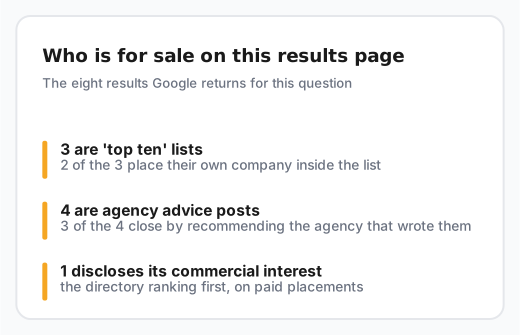
Of the 8 results Google returns for this question, 3 are “top ten” lists, and 2 of those 3 place their own company inside the list they are ranking, one of them at number 1, directly above a section explaining why to choose it. 4 more are advice posts published by agencies, and 3 of those 4 close by recommending the agency that wrote them.
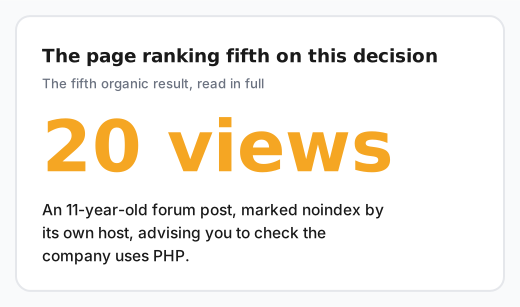
The result sitting fifth is stranger. It is a forum post 11 years old, with 20 views, marked by its own host as noindex so search engines were asked not to list it at all, carrying two links to a web development firm. Its central piece of technical advice is to check that the company uses PHP, a criterion from a different era of the web. That page ranks 5th today, on a decision somebody is about to spend a lakh of rupees on.
Two exceptions are worth naming, because they behaved well and nobody else on the page did. DesignRush, the directory ranking first, states plainly that “some featured placements are paid” the only disclosure of commercial interest anywhere in this set. And Genesis Ads gives its advice and stops, without a pitch at the end. It is the one advice page here that does not sell you the answer it just gave you.
Now the disclosure that this page owes you: Infiscroll builds websites in Pune. We are one of the companies you would be choosing between, and this page carries exactly the conflict described above. The rest of it is written to be useful anyway, which means every check below is one where the answer comes from evidence rather than from us.
What should you decide before you call anyone?
3 things, and all 3 are yours to decide rather than the agency’s. No firm can scope work against an undecided goal, and most of the arguments that happen later trace back to one of these being skipped at the start.
- What the site is for: leads, sales, or simply being findable. This changes the build more than the design does: a site meant to generate enquiries is structured around one thing, and a catalogue meant to sell is structured around another.
- What has to exist on it: a booking form, a payment gateway, a login area, a product catalogue. Write the list before anyone quotes, because a feature added after the quote is agreed is the most common reason an invoice grows.
- A budget range you are willing to say out loud. Agencies that know the range can tell you what fits inside it; agencies that do not will guess, and usually guess high.
Google’s AI Overview for this search opens with the same 3, and asks the reader for their primary goal before it will narrow anything down. On the budget, the figures and what moves them are on our website cost page rather than repeated here.
Which checks can you actually verify yourself?
5 checks, and the point of every one is that the answer does not come from the agency. This is the gap in the advice currently ranking for this question: it tells you what to look for, and almost none of it tells you what you can confirm without taking somebody’s word for it.
- Load 3 of their live sites on your own phone, on mobile data. Not screenshots, and not on office wifi. 6 of the 7 pages here say to check live links, what they leave out is what to measure: whether it becomes readable within 2 to 3 seconds, and whether anything is cut off or unreadable at that width.
- Confirm they actually built it. Ask which parts of the site were theirs. Portfolios legitimately include work done under subcontract, or sites since rebuilt by somebody else, and the question is normal enough that an honest firm answers it in a sentence.
- Ask for the tax and scope answers in writing. Whether the quoted figure includes GST, and what counts as a change of scope rather than a revision. A firm that answers both in a sentence has thought about them; one that cannot is telling you something useful. Both questions are covered on our cost page.
- Ask who the domain will be registered to. One question with one right answer: your business. Google’s own AI Overview for this search carries a whole section on this, telling readers to make sure they own the source code, the domain and the CMS admin rights after launch, so it is settled advice rather than ours.
- Ask for 2 clients you can contact yourself. Most of the value is in whether the firm agrees, and how quickly.
Every one of those is answered by evidence rather than assurance, which is the only kind of check that survives a page full of people who want your business.
Freelancer, agency or established company?
They differ mainly in what happens after launch, not during it. One of the pages ranking for this question draws the distinction better than the rest of the set, and it is worth repeating rather than reinventing: a freelancer works to a smaller budget with no long-term support behind them; an agency spreads the work across people responsible for different parts; an established firm is set up for complex, scalable builds.
The practical version of that test is a single question: who answers the phone in month 7, when something breaks and the person who built it is busy? A freelancer can be an excellent choice for a small brochure site, and a poor one if the site is the only way your customers reach you.
Size itself is not what you are buying. A two-person studio with a written support commitment is worth more than a large firm without one, and the commitment is checkable while the team size is just a number on an about page.
Does the locality matter?
For the code, no. For everything around it, sometimes. Google’s AI Overview suggests that agencies in tech hubs such as Hinjewadi or Aundh can offer contextual business alignment, and three of the ranking pages name Pune localities the same way, but the claim deserves a harder look than it usually gets.
A developer’s postcode does not affect code quality. A firm 2 kilometres away that never meets you is worth less than one across the city that does. What proximity genuinely buys is the ability to sit in a room while something is being decided, which matters most in the first 2 weeks and least afterwards.
The part of “local” that does affect results is knowing how customers in this market actually search, and that is local SEO work rather than development: a different discipline, sometimes sold by the same firm.
What if every shortlist looks the same?
When three firms all look plausible, stop comparing the pitches and compare the paperwork. This is where most buyers actually get stuck, and none of the pages ranking for this question addresses it.
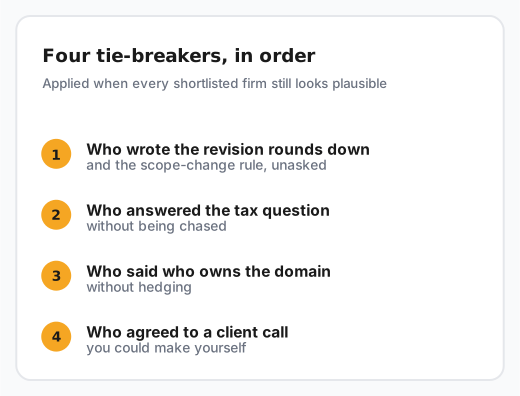
4 tie-breakers, in order: which firm put its revision rounds and its scope-change rule in writing without being asked; which answered the tax question without being chased; which said who the domain would be registered to without hedging; and which agreed to let you speak to a client. All four are things you already have by this point, if you asked.
The firm that writes things down before it has your money is showing you how it will behave once it does. That is the most reliable signal available to somebody who cannot judge code.
One more thing worth knowing about the evidence available to you: of the 3 discussion threads Google surfaces on this search, one is 9 years old and its top answer is an unprompted plug for an unrelated SEO firm, and another is a promotional listicle posted into a marketing forum 1 week ago. The only thread where the person asking was a buyer rather than a seller is 3 years old and has 7 replies. That is roughly how much independent local discussion exists, which is why the checks you can run yourself matter more here than reputation does.
So should you choose us?
Apply the same tests, and see where we land. A page arguing that you should demand evidence has to be willing to be measured by its own standard, so here is that measurement, including the part that does not flatter us.
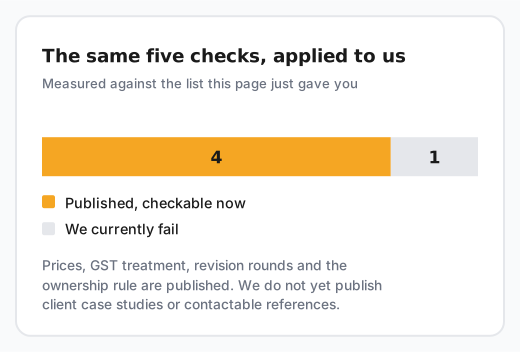
On the commercial questions we do well, and deliberately: our prices, our GST treatment, our revision rounds and our scope-change rule are published rather than quoted on request, and our terms state that you own the deliverables once the project is paid in full and that the domain belongs in your name. You can check all of that in about 2 minutes without speaking to anybody here.
On the fifth test we currently fail our own list. We do not yet publish client case studies or named references you can contact. A reader applying this page strictly asks us for both before deciding, and weighs the absence rather than ignoring it, which is exactly what we have just told you to do with everybody else.
That is the whole argument of this page in one example. The tests above work on everyone, including whoever wrote them, and a firm that will not be measured by them has answered the question for you.
FAQ
Choosing a web development company: questions answered
Six questions come up on almost every enquiry: what to check first, how to tell whether a portfolio is really theirs, freelancer or agency, whether the agency’s location matters, who should own the domain, and how to break a tie between two similar quotes.
What should you check before hiring a web development company in Pune?
Decide what the site is for, what features must exist on it, and a budget range, then check work you can load yourself, get the GST and scope-change answers in writing, and confirm the domain will be registered to your business.
How do you tell whether a portfolio is really theirs?
Ask which parts of each site were their work. Portfolios legitimately include subcontracted builds and sites since rebuilt by somebody else, and an honest firm answers the question in a sentence.
Should you hire a freelancer or an agency?
They differ mainly in what happens after launch. A freelancer suits a small brochure site on a smaller budget; an agency spreads work across people, which matters when the website is the main way customers reach you.
Does it matter if the company is in Hinjewadi or Baner?
Not for code quality. Proximity buys the ability to sit in a room while decisions are made, which matters most in the first 2 weeks. Knowing how local customers search is local SEO work rather than development.
Who should own the domain name?
Your business, registered in your name from the first day, with the agency holding access rather than title. Google's own AI Overview for this search says the same about the source code and CMS admin rights.
How do you choose between two similar quotes?
Compare the paperwork rather than the pitches: which firm put its revision rounds and scope-change rule in writing, answered the GST question without being chased, named the domain owner without hedging, and agreed to let you contact a client.
Want to run those checks on us?
Ask for the live sites, the written scope rule and the domain answer: the same three we just told you to ask everyone. A useful first message says what the site is for and roughly what has to be on it.
See what we build