How to Rank on Google Maps in Pune
Google publishes how local ranking works, and the page that explains it is the first result on this very search. It also states, in its own words, that a better local ranking cannot be requested or paid for, and of the 7 other pages ranking here, not one repeats that sentence.
What actually decides who ranks on Google Maps?
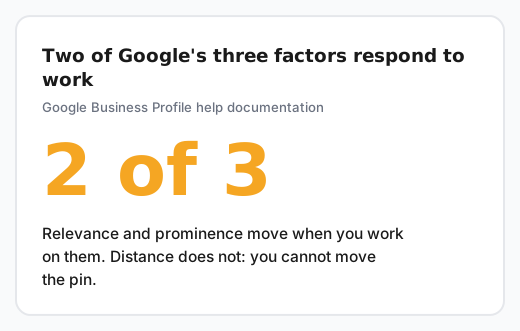
Three things, and Google names them itself: relevance, distance and prominence. That list is not an agency’s model or a reverse-engineered theory. It comes from Google’s own Business Profile support documentation, which is the first organic result on this exact search. The primary source is one click above every guide written about it, this one included.
Here is what each factor means in Google’s words, and what a Pune business can do about it:
- Relevance, how well your profile matches what someone searched for. Google’s own advice is to provide complete and detailed business information, which is the plainest instruction in the whole document.
- Distance, how far your business is from the person searching. Where they have not shared a location, Google uses what it knows about where they are.
- Prominence, how well known the business is, based partly on how many websites link to it and how many reviews it has.
Google’s own page uses the word popularity in its opening sentence and Prominence as the heading for that same third factor, so a reader comparing two guides may see both words. They are one factor, not two.
Three of the guides ranking on this search carry that framework too, so the model itself is not contested. What almost none of them draw out is the consequence of the middle factor. Distance is the one input you cannot optimise. A business in Kothrud will not appear for someone standing in Hadapsar no matter how complete its profile is, which means “rank number one on Google Maps in Pune” is not a coherent goal. There is no single Maps ranking for a city, only a result for each place a person is standing when they search.
One caution before the tactics, because it applies to every guide on this topic. Guides restate Google’s three factors accurately and then add specifics Google never published. When we captured Google’s own AI summary for a related Pune search twice within a few minutes, it told us to add photos weekly in one answer and monthly in the next. Treat any precise cadence, threshold or number as somebody’s estimate, including the ones below.
Can you pay to rank on Google Maps?
No, and Google says so itself, in the documentation ranking first on this search. The sentence is short and it is set apart as important, stating, according to Google’s Business Profile help documentation, that there is no way to request or pay for a better local ranking on Google, and that algorithm details are kept confidential to keep the ranking system as fair as possible for everyone.
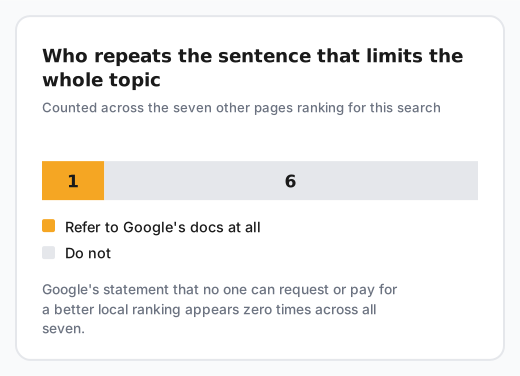
That line is the most useful sentence available on this topic, and it is missing from almost everywhere it should be. Across the 7 other pages ranking for this search, that statement appears zero times, and only 1 of the 7 refers to Google’s documentation at all. This is not an accusation against any of them; several are good, and one is the most thorough guide to Pune local search we found. It is simply that the primary source sits at the top of the results and the guides written around it mostly skip the one line that limits what any of them can promise.
Meanwhile the demand runs the other way, and Google shows it on the same page. The related searches on this query include “GMB ranking service” and “how to rank on google maps pune for free.” People are actively looking to buy the thing Google has just said is not for sale.
So the distinction matters, and it constrains what we sell too. Paying someone to do the work is legitimate: completing the profile, choosing categories, listing services, building a review habit, keeping details consistent. That is real labour and it moves relevance and prominence. Paying anyone for a ranking, a guaranteed position, or a place in the three-pack is buying something the seller does not control.
The test to apply to any vendor, including us, is a single question: which of Google’s three factors does your fee move, and how? A clear answer names work. An answer that promises a position is answering a different question, because the position is not the vendor’s to give.
The same logic covers reviews, and here the guides do agree. The most thorough page in this set warns against buying reviews on the grounds that Google’s review systems detect coordinated activity and that a suspended listing costs more than starting from zero. A review you would be comfortable showing the customer who wrote it is safe; anything bought is a risk taken with the profile you are trying to protect.
What can you actually change this week?
These 9 changes all live inside the Google Business Profile itself, and every one maps onto relevance or prominence: the 2 factors you can move. The website half of local SEO, along with citations, schema and what to measure in Search Console, is covered in our local SEO checklist for Pune businesses rather than repeated here.
- Verify the profile: an unverified profile does not rank at all, so confirm verification actually completed rather than that it was started.
- Choose the most specific accurate primary category: Google’s own summary of this query gives the example of preferring a precise category such as “Dental Clinic” over a broad one such as “Doctor”.
- Add secondary categories rather than substituting them: the primary carries the most weight, and the secondaries extend what you can be matched to.
- List every service individually, each with its own description, because each entry is a separate relevance signal rather than a repeat of the same one.
- Write the business description yourself, covering what you do, where you do it and who for, in language a customer would actually use.
- Keep hours and contact details current, including closures around festivals, which is the single most visible way a profile signals that somebody is maintaining it.
- Add real photos of the premises, team and work as a habit, and pick a cadence you will keep, because as noted above Google’s own answer varied between weekly and monthly.
- Ask satisfied customers for reviews steadily rather than in bursts, and reply to all of them: Google’s summary of this query suggests replying within 48 hours.
- Use Pune locality terms where they are genuinely true of you: the guides ranking here and Google’s own summary already name Baner, Wakad, Kothrud, Koregaon Park, Hinjewadi and Viman Nagar, and there is nothing to add to that list except honesty about which ones you actually serve.
One more, and it comes from the discussion thread Google serves alongside these results rather than from any of the guides: look at what the businesses already in the three-pack have published in third-party directories before you change anything of your own. It costs nothing and it tells you what the current bar looks like in your category.
Whether publishing in Marathi is worth doing is a real question with a real answer, and it belongs to the checklist article, which sets out the case and the evidence.
How do you know whether any of it worked?
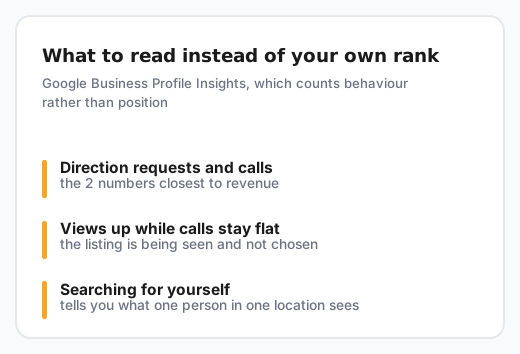
Not by searching for your own business, which is the least reliable check available to you. Because distance is one of the three factors, your position changes with where the searcher is standing, so there is no single number to find. Searching from your own office, on your own phone, tells you what one person in one location sees.
What replaces it is the profile’s own reporting. Google Business Profile Insights counts behaviour rather than position: how people found the listing, how many called, how many asked for directions, how many clicked through to the site. For a business customers physically visit, direction requests and calls are the 2 numbers closest to revenue, and neither depends on knowing your rank.
There is one pattern worth learning to read. If profile views rise while calls stay flat, the listing is being seen and not chosen, which is a problem with the photos, the reviews, the hours or the categories, not with ranking. Working harder on visibility at that point spends money on the half that is already working.
The website side of measurement, including the Search Console report that almost nobody tells you to open, is covered in the local SEO checklist for Pune businesses.
On timelines, the most thorough guide ranking for this search publishes 6 to 12 weeks for visible movement, and 4 to 8 weeks in less competitive PCMC areas. That is a reasonable published figure and it is theirs, not ours. We publish no timeline of our own, because we have no case data yet to base one on, and a number invented to sound confident is worth less than the admission.
If you would rather hand the work over, we run local SEO for Pune businesses from ₹8,000 a month with a ₹15,000 one-time setup, and the scope sits on our local SEO services in Pune page. Those figures exclude GST, which is added as applicable.
FAQ: ranking on Google Maps in Pune
These 6 questions come from the People Also Ask box on this search, from Google’s own AI summary and the 2 follow-up questions it asks, and from the discussion thread Google served alongside the results. Two of them are answered by refusing them, and the reasons are given rather than left implied.
Can I pay to rank higher on Google Maps?
No. Google's own Business Profile documentation, which is the first result for this search, states that there is no way to request or pay for a better local ranking, and that algorithm details are kept confidential to keep the system fair. Paying an agency to do the work is legitimate; paying anyone for a position is buying something the seller does not control. Ask any vendor which of Google's three factors their fee moves, and how.
How long does it take to rank on Google Maps in Pune?
The most thorough guide ranking for this search publishes 6 to 12 weeks for visible movement, and 4 to 8 weeks in less competitive PCMC areas. That figure is theirs and it is a reasonable one. We publish no timeline of our own, because we have no case data yet to base one on, and a number invented to sound confident would be worth less than saying so.
Do I need a website to rank on Google Maps?
No. A Google Business Profile can rank without a website, as the most detailed guide in this ranking set states plainly. A website still helps, because one of Google's three ranking factors is prominence, which is based partly on how many websites link to your business.
How can I check my Google Maps ranking?
Not by searching for yourself. Distance from the searcher is one of Google's three ranking factors, so your position changes with where the person searching is standing and there is no single number to find. Use Google Business Profile Insights instead, which counts behaviour rather than position: how people found the listing, how many called, how many asked for directions and how many clicked through.
Is 75 a good SEO score?
That number comes from a third-party audit tool, not from Google. Google publishes no SEO score for a business or a page, and no tool's score is an input to local ranking. The factors Google does publish are relevance, distance and prominence, and none of them is expressed as a score out of 100.
How do I make 100 to 200 a day from Google Maps?
We have nothing useful to say about this one. The question comes from a make-money-online genre rather than from running a business, and this article is written for Pune business owners trying to be found by nearby customers. It appears here because Google lists it alongside this search, and refusing it is more honest than answering it.
Want the work done for you?
What we sell is the work, not a position, because as Google states on the page ranking first for this search, no one can sell you a local ranking. We run local SEO for Pune businesses from ₹8,000 a month with a ₹15,000 one-time setup. Figures exclude GST, which is added as applicable.