Local SEO Checklist for Pune Businesses
The checklist is the easy part, and it is already everywhere. What is missing is which items you can actually verify, what Google said when we asked it the same question twice, and the one report nobody tells you to open.
Why does every local SEO checklist look the same?
Because nearly all of them contain the same 6 groups (Google Business Profile, website signals, citations, reviews, local content and tracking) and the market has now said so out loud. On the discussion thread Google itself serves for this query, the highest-voted reply says the commenter had already seen that exact checklist on ChatGPT. The person who posted it confirms it began life as a LinkedIn post. A third commenter went further and ran the test: he asked ChatGPT for a local SEO checklist and reports getting back a longer and more detailed list than the one published.
That exchange is worth more than any of the checklists. If a generated list is longer and more detailed than a published one, the list was never the valuable part. Deciding which items apply to your business, and proving the ones you have done are actually done, is the work that remains.
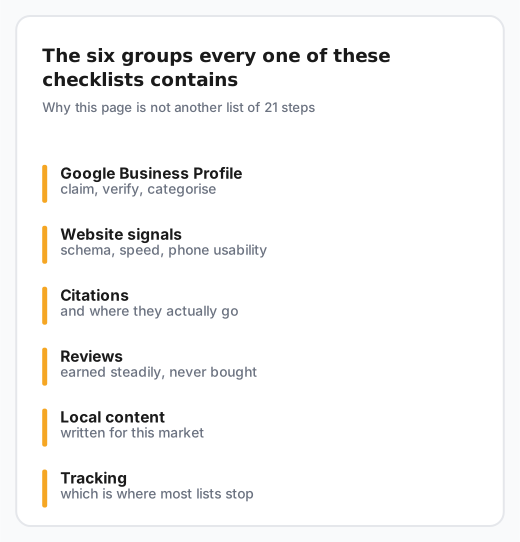
So this page is not another list of 21 steps. It covers 3 things a generated checklist cannot give you:
- What Google itself says, including what happened when we asked it twice.
- Which items you can verify today, in a browser, in one sitting.
- What to measure afterwards, including the report all 8 ranking pages leave out.
One page in this market does go further than a generic list, and it deserves naming rather than repeating. The guide ranking 4th publishes real Marathi-language search queries in Devanagari alongside their English meanings, and it sets out the festive search spikes that move local demand in Pune: Ganesh Chaturthi for caterers, decorators and sweet shops, Diwali for retail and gifting, and the March to June admissions season for coaching institutes, with the advice to update the profile about 2 weeks ahead. That is the most Pune-specific work published on this query and it is already done, so what follows adds to it rather than restating it.
What does Google actually tell you, and does it say the same thing twice?
Google publishes its own local SEO checklist for this query as an AI Overview, and asked the same question twice within minutes, it gave two different answers. The query was identical, the URL was identical, the country and language parameters were identical, personalisation was switched off, and the two runs were a few minutes apart. The structure held. The content did not.
| What was asked | First answer | Second answer |
|---|---|---|
| How often to post photos | Weekly | Every month |
| Category example given | “Dentist” | “Dental Clinic” |
| Fourth priority named | Geo-targeted on-page optimisation | Collecting regular customer reviews |
| Review strategy | A section of its own | Folded into the opening sentence |
The photo row is the one that matters, because it is the kind of instruction a checklist repeats as fact. Google gave both weekly and monthly for the same task, so neither is Google’s position and this page will not present either as one.
What did hold across both runs is the part worth acting on. Both told the reader to claim and verify the profile, use the exact legal or trading name without appending keywords, choose one precise primary category and add secondaries, keep the name, address and phone number identical everywhere, build citations on Indian platforms, add LocalBusiness schema, and keep the site fast and usable on a phone. The stable set is the real checklist; the parts that moved between runs are the parts to hold loosely.
That yields a rule worth more than any single item. When a page tells you Google wants something specific, check whether Google says it consistently: because on this query, twice in a row, it did not. How these answer engines behave, and what it takes to be quoted by them, is covered on our answer engine optimisation article.
Which parts of the checklist can you actually verify today?
These 9 checkpoints can each be confirmed as done or not done in a browser in one sitting, which is what separates a checklist from a to-do list. Every one has a way of knowing, not just a box.
- Profile claimed and verified: check that verification actually completed, by video or postcard, rather than that it was started.
- Exact business name. Open the profile and confirm the name matches your legal or trading name with no keywords appended to it.
- One precise primary category. Confirm the primary is the most specific accurate option, with secondaries added rather than substituted.
- NAP identical in 3 places: compare your site footer, your contact page and each directory listing character by character, including how the phone number is formatted.
- LocalBusiness schema present. View the source of your homepage and contact page and confirm the markup exists rather than assuming a plugin added it.
- Usable on a phone. Open your own site on your own phone on mobile data, and time how long it takes before you can tap the phone number.
- Duplicate listings removed. Search your business name and phone number and confirm old listings from a move or a rebrand are closed or merged.
- A competitor sanity check first. Look at the 3 businesses currently ranking for your term before changing anything, so you know what you are being measured against. This one comes from the practitioners on that discussion thread rather than from the published guides.
- Storefront or service area, decided honestly: a business customers visit publishes an address; a business that travels to customers publishes a service area instead of asserting half an address.
Two of those checkpoints, the category and the reviews. Are also the levers that decide whether you appear in the map results at all, which is a separate question with its own answer in our guide to ranking on Google Maps in Pune.
That last checkpoint has a matching failure worth naming, and the guide ranking 8th names it: building location pages for areas you do not actually serve. It is the same position we take on our own site, and it holds for a reason a checklist rarely explains: a page about an area you have never worked in has nothing true to say about it, so it reads as filler to a reader and to Google alike.
Where do the citations actually go?
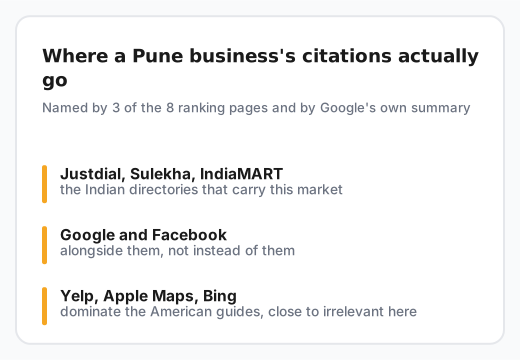
For a Pune business the directories that matter are the Indian ones, Justdial, Sulekha and IndiaMART: alongside Google and Facebook. Three of the 8 pages ranking for this query name that set, and so does Google’s own summary, so this is settled rather than contested.
That set is not guesswork on our part: three of the ranking guides name those directories, and, according to Google’s own AI Overview on this query, the platforms a Pune business should be listed on are Justdial, Sulekha, IndiaMART and Facebook. What is odd is how many pages tell a Pune business to build citations without saying where. One devotes a numbered step to building local citations and names no directory at all. Another names only tools rather than a single platform you could list on. Two never use the word citation. Meanwhile the default set that dominates English-language local SEO guidance (Yelp, Apple Maps, Bing) barely appears here, and is close to irrelevant for a business whose customers are in Pune. The instruction survives translation from the American guides; the platform list does not.
Reviews are the one place where the advice on this query openly conflicts. Google’s own summary prescribes a systematic review-generation workflow over WhatsApp or SMS, on the stated grounds that open rates in India beat email. The guide ranking 8th names buying or manipulating reviews as one of its 7 mistakes. Both are right, and the line between them is not subtle: asking a real customer who used your service to leave an honest review is a different act from manufacturing one, and only the first survives scrutiny. A review you would be comfortable showing the customer who wrote it is safe; anything else is a liability on the profile you are trying to protect.
On cleaning up existing listings, the honest answer is that we cannot recommend a service. A commenter on that discussion thread asks which citation clean-up service actually works, reports poor results from several, and nobody in the thread answers. What you can do without paying anyone: search your business name and your phone number, list every profile that appears, claim the ones you can, close or merge the duplicates, and keep one written record of your name, address and phone number that every future listing is copied from.
What should you measure, and what does nobody tell you to look at?
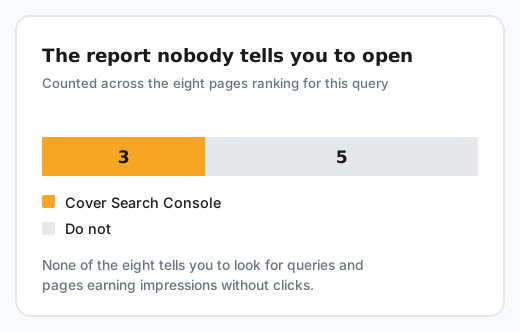
Measurement is not missing from this market: 3 of the 8 ranking pages cover Google Search Console, and one makes installing it its first numbered step. That is worth crediting before adding anything, because the common complaint that these guides ignore analytics is not true of this set.
What none of the 8 does is tell you to look for the queries and pages that earn impressions without earning clicks. That single report is the most useful one a local business can open, because it separates two problems that look identical from the outside: not being found, and being found and not chosen. A page with high impressions and almost no clicks has already won the ranking and is losing the visit: usually to a title that does not match what was searched, a missing price, or a profile that looks unmanaged next to the business above it.
The practitioners agree, and they got there first. On the discussion thread Google serves for this query, the first commenter’s objection to the checklist is precisely that it contains nothing about Search Console, indexing, or which queries and pages earn the clicks, and the person who posted the checklist concedes the point rather than defending it.
One counterweight, in our own words. Rankings are the number everyone reports because they are easy to screenshot, and calls, form submissions and direction requests are the numbers that pay for the work. A checklist that ends at “set up tracking” has stopped exactly one step before the useful part. Set it up, then go and look at which queries are already earning you impressions you are not converting.
If you would rather hand this over, we run local SEO for Pune businesses from ₹8,000 a month with a ₹15,000 one-time setup, and the full scope sits on our local SEO services in Pune page. Those figures exclude GST, which is added as applicable.
FAQ: local SEO for Pune businesses
This query served no People Also Ask box, so the 7 questions below are not scraped from one. They come from the categories and follow-up questions in Google’s own AI Overview, the two discussion threads Google served alongside the results, and the mistakes the ranking guides name themselves.
How long does local SEO take to show results in Pune?
The parts you control directly change immediately: a claimed and verified profile, a corrected business name, an accurate primary category and consistent contact details are all live as soon as you fix them. Rankings and reviews move slowly, because both depend on activity accumulating over months rather than on a single change. We publish no timeline for reaching a particular position, because nobody can honestly promise one.
How often should I post photos to Google Business Profile?
Google gave two different answers to this question within minutes of each other on the same search. One answer said weekly and the other said every month, so neither is Google's stated position. What holds across both is that a steady habit beats a burst followed by silence, so pick a cadence you can actually keep and keep it.
Which directories should a Pune business be listed on?
Justdial, Sulekha and IndiaMART, alongside Google Business Profile and Facebook. Three of the 8 guides ranking for this search name that set and so does Google's own summary. The directories that dominate English-language local SEO advice, such as Yelp, Apple Maps and Bing, matter far less for a business whose customers are in Pune.
Does Marathi-language content help local SEO in Pune?
There is a good case that it does, and the guide ranking 4th for this search makes it in detail, publishing real Marathi search queries and noting that Google indexes a Google Business Profile description in the language it is written. One supporting observation from our own research: Google has offered a Marathi version of its AI Overview on every one of the 8 searches we have captured for this site, which suggests Google itself treats Marathi as relevant to these queries.
Do I need a separate page for each Pune locality?
Only for areas you genuinely serve. Creating location pages for areas you have never worked in is named as a mistake by the guides ranking for this search, and it is our own position too: a page about an area you have no presence in has nothing true to say about it. A business without a public storefront lists a service area rather than asserting an address it does not have.
Can I pay someone to clean up my citations?
We cannot recommend a service. A practitioner on the discussion thread Google serves for this search asks exactly this question, reports poor results from several providers, and receives no answer. Doing it yourself is straightforward if slow: search your business name and phone number, list every profile that appears, claim what you can, close or merge duplicates, and keep one written record that every future listing is copied from.
What does local SEO cost in Pune?
Infiscroll runs local SEO for Pune businesses from ₹8,000 a month with a ₹15,000 one-time setup. Those figures exclude GST, which is added as applicable, and the full scope sits on our local SEO services page.
Want this run for you?
Everything above is doable without hiring anyone, and that is the point of publishing it. If you would rather not, we run local SEO for Pune businesses from ₹8,000 a month with a ₹15,000 one-time setup. Figures exclude GST, which is added as applicable.