What Is E-commerce? Meaning, Types and How It Works in India
The definition takes one sentence. The useful part is what it means for someone selling in India, where the buyer often pays cash at the door, and where almost every guide answering this question was written for somewhere else.
What is e-commerce?
E-commerce is buying and selling goods and services over the internet: on a computer, a tablet or a phone. Google’s own summary of this question gives 3 everyday examples that cover most of it: online retail shopping, digital downloads, and food delivery apps.
The plainest definition we found anywhere was not in a published guide. On the discussion thread Google ranks for this exact search, a reply scoring 14 points puts it as the simple concept of selling online. Shorter than any definition in the 7 guides ranking above it, and worth crediting for that.
What is more useful is why that thread exists at all. The person who started it was not looking for a taxonomy. He had been watching get-rich-quick videos about e-commerce and wanted to know whether what he had been told was true, whether it meant building an Instagram page, gathering followers and then opening a store. The highest-voted reply, at 15 points, told him that content of that kind understates how hard any business is, and another added that it is much harder than putting up a Shopify store.
That is the honest framing for a definition page, and it changes what this one is for. A definition is available from any tool you can open in 10 seconds. So the rest of this page spends its length on the part that is actually specific to where you are selling, which is the part the guides ranking for this question leave out almost entirely.
What are the types of e-commerce?
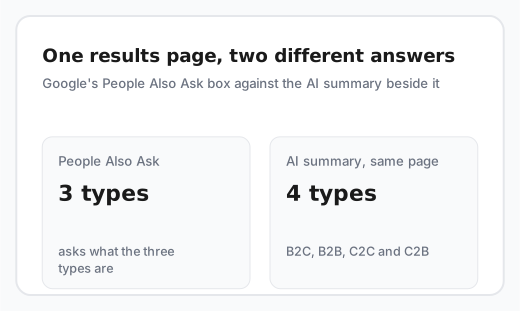
There are 4, and Google disagrees with itself about that on this very search. Its People Also Ask box asks for three types while its own AI summary on the same results page lists four. The honest answer is four, and the shorter version usually just drops the last one.
- B2C, business to consumer: a business sells directly to a shopper, which is most online retail.
- B2B, business to business: one company sells products or services to another, usually in larger quantities and on agreed terms.
- C2C, consumer to consumer: people sell to other people through a marketplace that handles the introduction.
- C2B, consumer to business: an individual sells a skill or service to a company, which covers most freelance work.
One of the People Also Ask questions on this search asks whether Amazon counts as e-commerce. It does, but selling on a marketplace and running your own store are 2 different businesses with different economics, and which one suits you is a decision worth making before you choose any software. That comparison, including what each platform costs an Indian business in rupees, sits in our guide to the best e-commerce platform in India.
Dropshipping comes up constantly alongside this question and this page does not cover it. That is deliberate: it is a distinct model whose honest account needs margins, supplier reliability and Indian delivery times treated properly, and a paragraph here would mislead more than it explained.
What does starting actually involve in India?
The mechanics of e-commerce are the same everywhere; the transaction is not. An Indian buyer frequently pays cash on delivery, and pays digitally through UPI rather than through the cards-and-wallets default that global guides assume. That single difference changes your cash flow, your returns rate and your checkout before it changes anything about your website.
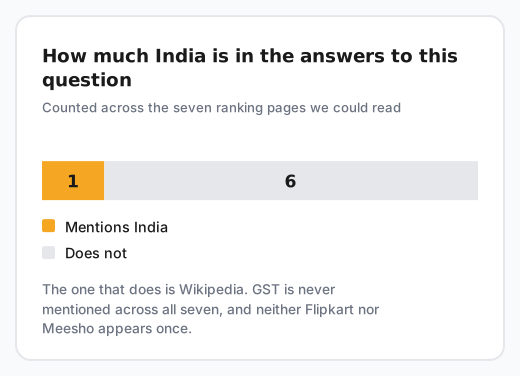
It is also almost entirely missing from the pages that answer this question. Of the 7 ranking pages we could read, only 1 mentions India at all, and it is Wikipedia, the single page in the set with no commercial targeting of any kind. Wikipedia is also the only one that states the fact that matters most here: according to Wikipedia’s own entry on e-commerce, in India cash on delivery is the most preferred payment method.
Two of the other ranking pages are served from India-specific web addresses and contain no India-specific content between them. One has zero mentions of India in its text. The other uses dollar figures and American retail examples throughout, and its only rupee figure is an advertisement for its own product. The price of the product is localised; the article is not. Across all 7, GST is never mentioned, and neither Flipkart nor Meesho appears once. Google’s own AI summary does name UPI, so the summary carries more India than almost every page beneath it.
So here is what an Indian seller actually has to decide, none of which the global guides raise:
- How the buyer pays, and whether you accept cash on delivery at all. It widens your market and costs you certainty.
- What happens to a cash-on-delivery order refused at the door, because you have already paid to ship it twice.
- GST-compliant invoicing from the first order, not retrofitted after the first quarter.
- Shipping that reconciles against orders, so what left matches what was paid for.
- A returns flow that a customer can use without contacting you.
How Shopify, WooCommerce and Magento each handle those is a comparison in its own right, and it is in the platform guide rather than here. What building one costs is on our e-commerce website development in Pune page: a Shopify or WooCommerce store starts from ₹30,000 and a custom build from ₹40,000, in about 4 to 6 weeks. Both figures exclude GST, which is added as applicable.
Why is half this search about jobs?
Because a large share of the people typing this question want a career in e-commerce rather than a business, and Google’s results are built around that. It is worth knowing before you read anything else that ranks for this phrase.
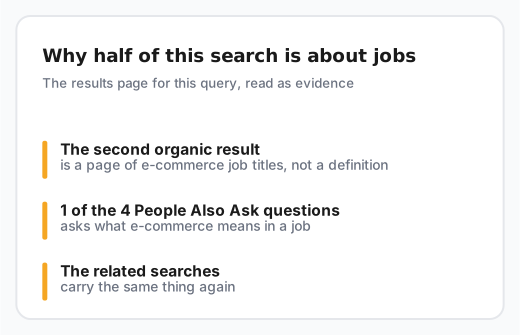
The evidence sits on the results page itself. The second organic result is a page of e-commerce job titles rather than a definition, one of the 4 People Also Ask questions asks what e-commerce means in a job, and the related searches carry the same thing again. The discussion thread Google ranks agrees from the other direction: one reply tells the beginner who started it to work towards a job in e-commerce, on the grounds that he will do better being paid by someone while he learns the basics.
That cuts both ways, and neither way is a problem. If you are here to build a business, a meaningful share of what ranks for this phrase was written for jobseekers and will not help you. If you are here for a job, that is a legitimate route into the field and the forum’s advice is sound. Learning the work on somebody else’s budget is cheaper than learning it on your own.
If you are in the first group, the next decision is not a definition. It is whether you sell through a marketplace or build your own store, and after that, what you build it on.
FAQ: e-commerce basics
These 6 questions come from the People Also Ask box on this search, from Google’s own AI summary and the 2 follow-ups it offers, and from the discussion thread Google ranks alongside the results. Two of them are answered by stating what we cannot honestly tell you.
What are the three types of e-commerce?
There are four, and the shorter list usually drops the last one. B2C is a business selling directly to a shopper. B2B is one company selling to another. C2C is people selling to other people through a marketplace. C2B is an individual selling a skill or service to a company. Google's own People Also Ask box asks for three while its AI summary on the same results page lists four.
Is Amazon part of e-commerce?
Yes. Amazon is e-commerce, and so is a single-product store run from a spare room. The distinction that matters commercially is not whether something counts, but whether you sell on a marketplace someone else owns or run your own store. Those are two different businesses with different economics, and our platform comparison covers which suits which kind of seller.
How do people pay for online orders in India?
By UPI, by card, by digital wallet, and very often in cash at the door. Google's own AI summary of this question names UPI alongside cards and wallets. Wikipedia is the only page ranking for this search that states the point that matters most for planning: in India, cash on delivery is the most preferred payment method. That affects your cash flow and your returns rate before it affects anything about your website.
How much does it cost to start an online store in India?
A Shopify or WooCommerce store starts from ₹30,000 at Infiscroll and a custom e-commerce build from ₹40,000, in about 4 to 6 weeks. Those figures exclude GST, which is added as applicable, and they cover the build rather than the platform's own monthly subscription, which our platform comparison sets out separately in rupees.
How much money can you make from e-commerce?
We publish no figure, because we have no honest basis for one. Earnings depend entirely on the product, the margin and whether demand exists, and none of those is something a web development studio can forecast for you. An income promise attached to a business model is the defining feature of the get-rich-quick content that the discussion thread ranking for this search warns beginners about.
Do I need GST registration to sell online?
This is a tax question rather than a web question, and it should be confirmed with a chartered accountant. Registration requirements depend on your turnover, what you sell and which states you sell into, so no general answer published on a website is safe to act on. What we can state is our own position: every figure we publish excludes GST, which is added as applicable.
Building an online store in India?
We build the store, which is the part we can be held to, not the outcome, which depends on your product and your margin. A Shopify or WooCommerce store starts from ₹30,000 and a custom e-commerce build from ₹40,000, in about 4 to 6 weeks. Figures exclude GST, which is added as applicable.