Best E-commerce Platform in India: Shopify vs WooCommerce vs Magento
Shopify to launch fast, WooCommerce if you already run WordPress and sell on content, Magento only when the catalogue and the team justify it. Every page ranking in India for this comparison prices these platforms in US dollars, while Shopify shows an Indian visitor rupees on its own pricing page. Here is the comparison in the currency you actually pay in.
Do you want a marketplace or your own store?
These are two different decisions, and comparing Shopify, WooCommerce and Magento only matters once you have made the first one. Selling through Amazon India, Flipkart, Meesho, Myntra or Nykaa means renting an audience that already exists and accepting the rules that come with it. Building on Shopify, WooCommerce or Magento means owning the storefront and bringing the traffic yourself.
Google does not resolve this either. Its AI Overview for best ecommerce platform india splits its answer into two labelled halves, marketplaces first, store builders second, and then, according to that same summary, asks the searcher a qualifying question before narrowing further: are you looking to buy products or sell products, and what type of product do you offer. An answer engine that ends by asking what the question meant is a reliable signal that the query carries 2 intents rather than 1.
The marketplace route gives you 4 things worth naming:
- Existing demand: buyers arrive already searching for the product category.
- Fulfilment and logistics. Handled for you on the larger platforms, at a fee.
- Payment collection. Settled by the marketplace rather than by you.
- Category reach: specialist platforms concentrate one kind of buyer.
Your own store gives you 4 different things, and they are the reasons businesses eventually build one:
- The customer relationship: the order data and the email list are yours.
- Margin control: no per-order commission taken off the top.
- Brand presentation: the page is yours to design rather than a template slot.
- Pricing freedom: no platform rules on discounting or positioning.
If the question behind all this is a more basic one (what e-commerce is, what its types are, and what selling online in India actually involves) our guide to what e-commerce is covers it. The rest of this page is for the second group. Every one of the 8 pages ranking for the three-way comparison assumes you already belong to it and none of them says so, which is why the first question is worth asking out loud.
Which three platforms is this comparison actually about?
Shopify, WooCommerce and Magento: the 3 platforms Google’s own summary of this query calls the top three e-commerce solutions, and the 3 that Indian businesses ask us to build on. Naming the boundary matters, because the searches around this one ask about others: OpenCart and PrestaShop both appear in Google’s related searches, and the discussion thread ranking 7th compares 4 platforms by adding BigCommerce.
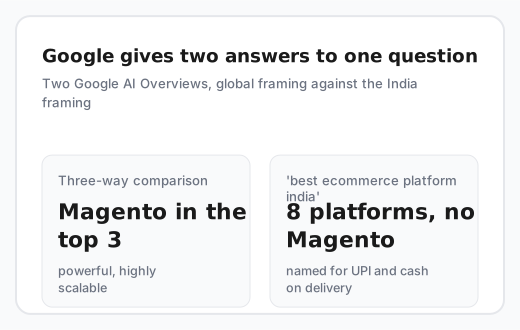
There is a more interesting fact sitting one query away, and it is the reason this page exists in this shape. Ask Google for the best ecommerce platform india rather than for the three-way comparison and its AI Overview names 8 platforms across marketplaces and store builders, and Magento is not one of them. Its third store builder is Dukaan or Instamojo, named, as that summary puts it, for Indian payments such as UPI and cash on delivery and for quick setup. Google gives 2 different answers depending on whether you frame the question globally or locally, and only the local one mentions Indian payment rails.
What this page deliberately leaves out, and why:
- OpenCart, PrestaShop and BigCommerce. Capable platforms that Indian businesses rarely bring to us, so we have no first-hand basis for ranking them against the other three.
- Dukaan and Instamojo. Quick-setup storefront tools rather than platforms a custom store is built on, which makes them a different purchase from the three compared here.
What does each platform actually cost an Indian business?
Platform cost has 3 parts (the subscription, the cut taken per transaction, and whoever maintains the thing) and only the first is a published number. That is where the comparison you find online stops being useful in India, because of the 8 pages ranking for this query, 5 publish prices in detail and every one of them publishes those prices in US dollars. Not one of the 8 publishes a single rupee figure, including the 2 published on Indian domains.
Shopify, meanwhile, quotes an Indian visitor in rupees on its own pricing page. Both figures below are published prices, taken from the source that publishes them; they are not a conversion of each other, and this page asserts no exchange rate between them.
| Shopify plan | Quoted by the ranking articles | Published by Shopify for India |
|---|---|---|
| Basic | $39 per month | ₹1,994 per month |
| Grow | rarely quoted | ₹7,447 per month |
| Advanced | $299 to $399 per month | ₹30,164 per month |
| Plus | around $2,300 per month | from ₹1,75,000 per month |
Annual billing lowers the first 3 tiers to ₹1,499, ₹5,599 and ₹22,680 per month, and the retail point-of-sale add-on is quoted separately at ₹7,000 per month per location. The gap matters most at the entry tier, where a business comparing platforms on a $39 figure is working from a number it will never be charged.
Google’s summary of this query is no help here either: it asks the searcher what their budget range is while publishing no figure in any currency anywhere in its own answer.
WooCommerce has no subscription to quote, and that is the honest answer rather than a cheaper one. The plugin is free, so the cost is hosting, whichever paid extensions the store needs, and whoever keeps the stack updated. There is no single published number for that and any article giving you one has invented it.
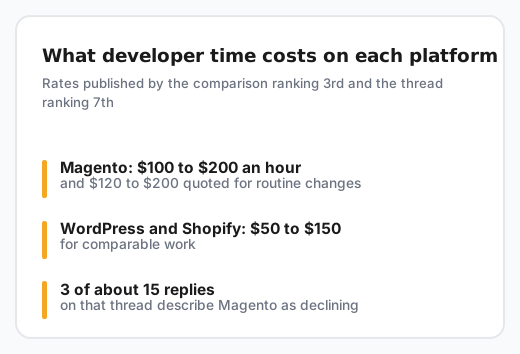
Magento’s cost is people. The open-source edition is free to download and the expense arrives as developer time and hosting: the comparison ranking 3rd puts Magento developers at $100 to $200 an hour against $50 to $150 for WordPress and Shopify work, and the discussion thread ranking 7th quotes $120 to $200 an hour for routine changes. Both figures come from the pages that published them rather than from us.
One reframing is worth more than any of these numbers, and it comes from a comment on that ranking thread rather than from any of the articles: a percentage taken per sale feels cheap to a business starting out and gets expensive once it is established. The same transaction fee is a different product at 50 orders a month than at 5,000, which is why comparing subscription tiers alone misleads growing stores.
Our own numbers, for the build rather than the platform: a Shopify or WooCommerce store starts from ₹30,000 and a custom e-commerce build from ₹40,000, in about 4 to 6 weeks. Both figures exclude GST, which is added as applicable. The scope behind each sits on our pricing page, and what a website costs in this market more generally has its own article.
How do the three handle UPI, cash on delivery and GST?
All 3 platforms support Indian payment methods and cash on delivery through gateway integrations and add-ons rather than natively, so the real difference is how much of the work is configuration and how much is development. This is the part of the comparison that the ranking set does not cover at all: across all 8 pages, UPI, cash on delivery and GST appear 0 times, the word India appears once, and exactly 1 payment gateway is named anywhere in the entire set.
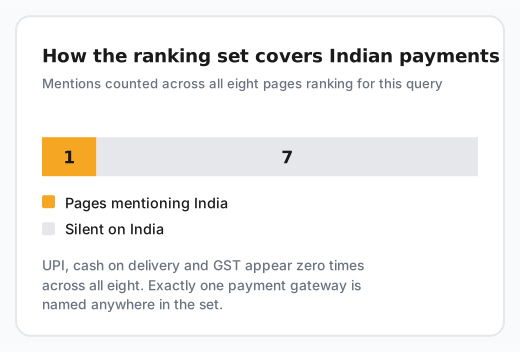
Google treats the same subject as the deciding factor the moment the query mentions India. Its summary for that query recommends 2 local platforms specifically, as it puts it, for Indian payments such as UPI and cash on delivery: a criterion that vanishes completely from its answer to the global three-way comparison.
Where the 3 platforms differ in practice:
- Shopify. Indian gateways and cash-on-delivery flows are installed and configured from its app ecosystem, which makes setup fast and leaves you dependent on the app’s publisher for updates.
- WooCommerce: the same capabilities arrive as plugins, with more configuration exposed to you and more responsibility for keeping each plugin current.
- Magento: the same capabilities arrive as extensions or as custom development, which is the most flexible and the most expensive of the 3 routes.
The question worth asking a developer is not whether a platform supports UPI, because all 3 do. It is who fixes the integration when a gateway changes its requirements, and whether that person is on your team, on ours, or at a plugin vendor you have never spoken to. What an Indian store needs beyond the cart (GST-compliant invoicing, shipping that reconciles against orders, a returns flow) is set out on our e-commerce website development in Pune page.
Is Magento still the right third platform in 2026?
The market disagrees with Google about this, and the disagreement sits on a single page of search results. Google’s summary of the three-way comparison names Magento one of the top three e-commerce solutions and describes it as powerful and highly scalable, built for large enterprises with complex multi-store and business-to-business requirements. That is a fair description of what Magento does.
The discussion thread ranking 7th on that same results page reads very differently. Of roughly 15 substantive replies, 3 describe Magento as declining, including the thread’s most-upvoted comment, which calls it and BigCommerce systems of the past that are losing share in business-to-business. A second calls it old hat and reports companies at multi-million revenue moving off it. A third puts routine developer work at $120 to $200 an hour.
That is one self-selected thread with about 15 replies and no sample frame, and it is not a market measurement. It is worth reading precisely because it is practitioners answering a buyer, and it is worth discounting for exactly the same reason.
The other side has an interested party arguing it, which is a reason to read carefully rather than to dismiss. The comparison ranking 3rd is published by a Magento hosting company, and it documents the platform’s capabilities at greater length and with more precision than any other page in the set. The set also concedes that the question is live: the article ranking 2nd carries the question is Magento still worth it in 2026 in its own list of frequently asked questions.
Our position, and it is narrower than either side. Magento’s cost is in people rather than in licences, so the number to check before choosing it is the cost and availability of the developers who maintain it, not the platform’s feature list, which is not in dispute. For most Indian businesses building a first or second store, that number decides the question before any feature comparison does.
Which platform suits which kind of Indian business?
Three things you can check today decide it: how many orders you take in a month, whether anybody maintains the site after launch, and whether the store sells on content. Google’s own decision guide reaches the same shape and it is worth crediting rather than restating as though it were new: choose Shopify to launch quickly without technical overhead, WooCommerce if you are on WordPress and want content and code control, Magento for a large enterprise catalogue with multi-store and business-to-business needs.
What that guide does not do is express any of it in terms an Indian business can check against its own numbers. Ours, by business stage:
- First store, under about 100 orders a month, nobody technical in-house: Shopify. The subscription buys you hosting, security and updates that you would otherwise pay somebody to do.
- Already running WordPress, selling partly through articles and search: WooCommerce. The store sits inside the site that already earns the traffic.
- Established store, growing order volume, a developer on call. WooCommerce or Shopify, decided by whether you want control of the code or freedom from maintaining it.
- Large catalogue, multiple storefronts or business-to-business pricing, an in-house team. Magento, once the developer cost is confirmed.
One trade-off is genuinely unresolved and no ranking article mentions it. On the discussion thread, a shop owner building a content-heavy store argues that Shopify’s blog is the weak point, with the specific objection that article URLs are forced under a /blog/ path. Other commenters disagree flatly, one calling the blog function perfectly fine, and the exchange ends without resolution. A third suggests running commerce on Shopify and content on WordPress separately, which is a real option rather than a settled recommendation. If your store depends on publishing, treat this as a question to test rather than a matter already decided.
The 2 mistakes the comparison set names most often are worth repeating because both are avoidable: choosing on launch speed alone, and leaving maintenance out of the cost. A commenter on that same thread rejects all 3 platforms in favour of custom development, an argument covered on our WordPress vs a custom website article rather than reopened here.
What does switching platforms later involve?
This is one of the better-covered parts of the comparison, so the useful answer is to say who covers it well rather than to repeat them. Migration between these platforms is documented in detail by 3 of the 8 ranking pages, and their coverage is genuinely good.
The comparison ranking 3rd sets out a migration cost breakdown and notes that product data, customer accounts and order history move through migration tools or scripts while URL structures change, making redirects necessary. The article ranking 6th makes the more valuable point: platform migrations usually fail on the search side rather than the technical one, and redirect mapping, canonical tags and URL mapping have to happen alongside the data move rather than after it. The article ranking 2nd documents that moving into Shopify from either of the other two is a supported path covering products, customer records and order history.
The one cost none of them states is worth adding. Whatever was custom-built on the old platform is rebuilt rather than migrated: a checkout customisation, a pricing rule or an integration with your accounting system moves as a specification, not as data.
FAQ: choosing an e-commerce platform in India
The 7 questions below are the ones Google and the discussion threads actually attach to this comparison: 4 of them come from the People Also Ask box on the India query, and the rest from the questions Google’s own summaries ask searchers before narrowing their answer. Two are answered by refusing them: we do not rank India’s largest sellers, and we do not price a platform we have not checked at source.
What are the top 5 e-commerce platforms?
The platforms most Indian businesses actually choose between are Shopify, WooCommerce and Magento, with OpenCart and PrestaShop appearing next in Google's related searches and BigCommerce in practitioner discussions. Google's own summary of the India query answers differently again, naming 8 platforms split between marketplaces such as Amazon India, Flipkart and Meesho and store builders such as Shopify, WooCommerce and Dukaan, and not naming Magento at all.
Which e-commerce platform is cheapest to start with?
Shopify publishes the lowest entry figure an Indian business can check before committing: ₹1,994 per month on its Basic plan, or ₹1,499 per month billed annually. WooCommerce has no subscription at all, so its starting cost is hosting plus whichever paid extensions the store needs, which varies too much to quote as one number. The platform that is cheapest to start is rarely the one that is cheapest to run, because maintenance is the larger cost over 3 years.
Do I need a developer to run an online store?
Shopify runs without one for a standard store, because hosting, security and updates are handled inside the subscription. WooCommerce usually needs somebody technical on call, since plugin updates, hosting and security stay your responsibility. Magento needs developer access as a condition of using it, and the cost of that access is the main figure to check before choosing it.
How large does a catalogue need to be before Magento makes sense?
Catalogue size alone rarely decides it. Magento earns its cost when a store runs multiple storefronts, business-to-business pricing rules, or product data complex enough that configuration stops being enough, and when a developer is available to maintain it. A large but simple catalogue runs on Shopify or WooCommerce without difficulty.
Can I take cash on delivery and UPI payments on all three platforms?
Yes. All 3 platforms support Indian payment methods and cash on delivery through gateway integrations, apps or extensions rather than as built-in features. The difference is how much of the work is configuration and how much is development, and who is responsible for fixing the integration when a payment gateway changes its requirements.
Is Zoho Commerce free?
This comparison does not cover Zoho Commerce, and we have not verified its pricing at source, so publishing a figure for it here would be guesswork. The 3 platforms compared on this page are Shopify, WooCommerce and Magento, and their costs are set out in rupees where the vendor publishes them in rupees.
Do your prices include GST?
No. Every figure we publish excludes GST, which is added as applicable. A Shopify or WooCommerce store starts from ₹30,000 and a custom e-commerce build from ₹40,000, in about 4 to 6 weeks, and the scope behind each figure is set out on our pricing page.
Building a store in Pune?
We build on all 3 of these platforms, so we are not a neutral party in this comparison and you should read it knowing that. What we can tell you honestly is what each one costs to run and what it costs to maintain. A Shopify or WooCommerce store starts from ₹30,000 and a custom e-commerce build from ₹40,000, in about 4 to 6 weeks. Prices exclude GST, which is added as applicable.