WordPress vs a Custom
Website: Which Should You Build?
WordPress for almost every business website. Custom when the website is the product rather than the shopfront. Everyone else answers this in dollars or euros: including Google, whose own summary of this question prices custom development at $15,000 to $50,000. Here is the answer in rupees.
What is the actual difference?
One is a content system you configure; the other is software written from scratch, and the difference that matters commercially is who can change the site next week. The table below sets out the 5 dimensions that actually decide the choice, rather than the 12 that usually get listed.
| Dimension | WordPress | Custom |
|---|---|---|
| What it is | A content system you configure and extend | Software written for you from scratch |
| Who edits it after launch | Anyone in your team, from a browser | Whoever wrote it, or somebody they hand over to |
| Time to launch | Days to weeks | Months |
| What slows it down | Plugins nobody removed | Very little you did not write |
| What breaks it | An unmaintained plugin | An unmaintained developer relationship |
All 7 pages ranking for this question describe the same trade-off, and 6 of the 7 warn about plugin bloat, so none of that is contested. What they leave out is what either option costs where you are.
What does each one actually cost in rupees?
₹20,000 for a static business site and ₹30,000 for the WordPress CMS tier where your own team edits the content, both excluding GST, both at 2 to 4 weeks: the scope for each sits on our pricing page. Custom development is a different order of magnitude and has its own page.
That answer is unusually hard to find. Not one of the 7 pages ranking for this question publishes a rupee figure, including the 2 written specifically for Indian businesses. One of those two carries a section headed “Cost Comparison in the Indian Market” whose entire content is that WordPress is low to medium and custom is medium to high. Elsewhere in the same set, one agency quotes 60 separate dollar figures and another prices in euros.
Google is no more local either: according to the AI Overview it serves for this search, custom development averages $15,000 to $50,000 and up, roughly ₹13 lakh to ₹44 lakh. But the AI Overview Google serves for “how much does a website cost in Pune”, in the same week and on the same Indian search domain, puts a custom web application at ₹2,00,000 to ₹5,00,000.
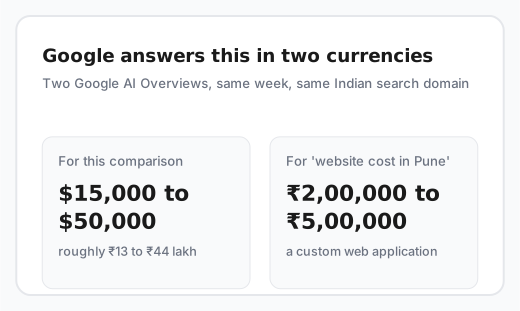
Both figures can be true of different markets, and that is the point. A dollar range describes what custom software costs where it is commissioned in dollars. It is not the number an Indian buyer should be anchoring a decision to, and it is 6 to 9 times the figure Google itself gives when the question mentions Pune.
Who ends up owning the code, and what either option costs to keep running each year, are covered on our website cost page rather than repeated here.
Why does this comparison read so badly?
Because most of it is developers answering a question business owners asked. That sounds like a complaint and it is really a reading instruction.
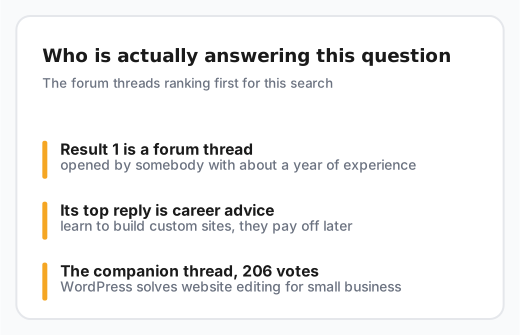
The result ranking first for this search is a forum thread opened by somebody with about 1 year of web development experience, asking which option to build. Its most-upvoted reply is career advice: learn to build custom sites, because in the long run those skills pay off. That is good counsel for a junior developer and almost irrelevant to a business deciding what to buy.
The community says so itself. On the companion thread, a heavily-upvoted reply complains that it is “a thread full of people who don’t build WordPress sites” developers noticing that the question keeps being answered by people with no experience of the thing they are dismissing.
A developer choosing what to learn and an owner choosing what to buy are answering different questions, and the developer’s answer systematically undervalues the thing an owner needs most: being able to change the site without hiring anyone. The top answer in that same thread, with 206 votes, says exactly that: WordPress critically solves website editing for small and medium businesses.
What can you not do on WordPress?
Fewer things than the comparisons suggest, and the real limits are specific. Two of them matter.
The first is when the website is the product rather than a shopfront for it: a marketplace, a SaaS tool, a booking engine with rules nobody else has. At that point you are fighting the content system rather than using it, and every feature costs more than it would have cost to write directly.
The second is maintenance debt. A site carrying 20 plugins that nobody updates degrades in speed and in security, which 6 of the 7 pages here correctly warn about.
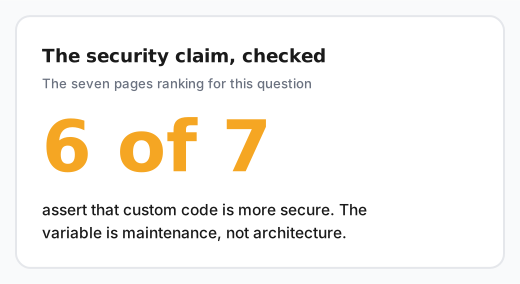
One claim in that set deserves a harder look: 6 of 7 assert that custom code is more secure, and that is not quite right. WordPress is attacked more because it is common, not because it is weaker, and an unmaintained custom site, with no update path and no one left who knows the code, is in worse shape than a maintained WordPress one. The variable is maintenance, not architecture.
What if you pick wrong?
One page in this ranking set raises it, and it is right to. It points out that a business can outgrow a theme and need to move, and that changing a theme does not mean losing everything. It is the only one of the 7 that mentions the possibility at all.
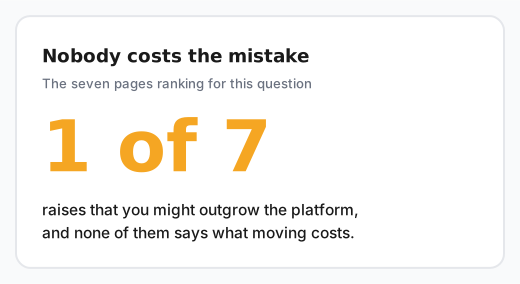
What none of them answers is what moving actually costs, so here it is. Your content and your domain move with you, because they are yours. The design does not. Moving off WordPress means rebuilding the front end and re-importing the content: a real project, but a fraction of starting again, and nothing about your business stops while it happens.
That asymmetry gives you the decision rule. Moving up is normal and moving down is rare, so the cheaper mistake is starting on WordPress and outgrowing it, not commissioning custom software you turned out not to need. What you keep either way is covered on our cost page.
Which one is right for your business?
WordPress for almost every business website in Pune; custom when the website is the product. The two lists below are Google’s own decision checklist for this question, and they match what the ranking set says, so they are worth using rather than rewriting.
Choose WordPress if:
- Your budget is limited.
- You need to launch within 2 to 6 weeks.
- You are running a business showcase, a blog, or a straightforward shop.
- Your team wants to add and edit content without involving a developer.
Choose custom if:
- The platform is the product: a SaaS tool, a marketplace, a booking engine with its own rules.
- You need complex automated workflows or membership data structures.
- You have strict compliance or data-residency requirements.
- Total control of the codebase is a business priority rather than a preference.
The first list describes most businesses, and there is no prize for buying the more expensive answer. If you are unsure which list you are on, the question that settles it is whether your customers would still get what they came for if the site were a well-organised brochure with a form on it.
FAQ
WordPress vs custom: questions answered
Six questions come up on almost every enquiry: the real difference, what each costs in rupees, whether WordPress is good enough for a business, whether custom is more secure, what happens if you outgrow it, and how long each takes.
What is the real difference between WordPress and a custom website?
WordPress is a content system you configure, so anyone on your team can edit the site from a browser. A custom website is software written from scratch, so changes go through whoever wrote it.
What does each option cost in rupees?
Infiscroll builds WordPress business sites from ₹20,000 static and ₹30,000 for the CMS tier where you edit content yourself, both excluding GST at 2 to 4 weeks. Custom development is a different order of magnitude and is quoted separately.
Is WordPress good enough for a serious business website?
For almost every business website, yes. The most-upvoted answer in the largest developer discussion on this question puts it plainly: WordPress solves website editing for small and medium businesses, which is the thing owners need most.
Is a custom website more secure than WordPress?
Not automatically. WordPress is attacked more because it is common, but an unmaintained custom site with no update path and nobody left who knows the code is in worse shape than a maintained WordPress one. The variable is maintenance, not architecture.
What happens if you outgrow WordPress?
Your content and domain move with you because they are yours; the design does not. Moving means rebuilding the front end and re-importing content. A real project, but far smaller than starting again, which is why starting on WordPress is the cheaper mistake.
How long does each take to build?
Days to weeks for WordPress and months for custom development. Our own WordPress builds run 2 to 4 weeks, and what usually extends that is waiting for content rather than development.
Not sure which list you are on?
Infiscroll builds WordPress business sites in Pune from ₹20,000, and ₹30,000 where you edit the content yourself. A useful first message says what the site has to do, not what it should be built in.
See full pricing